Welcome to the eighteenth edition of the This is the North podcast newsletter.
"I Just Wanted to Know If It's Any Good"
By Alison Dunn, with insights from Claire Malcolm MBE.
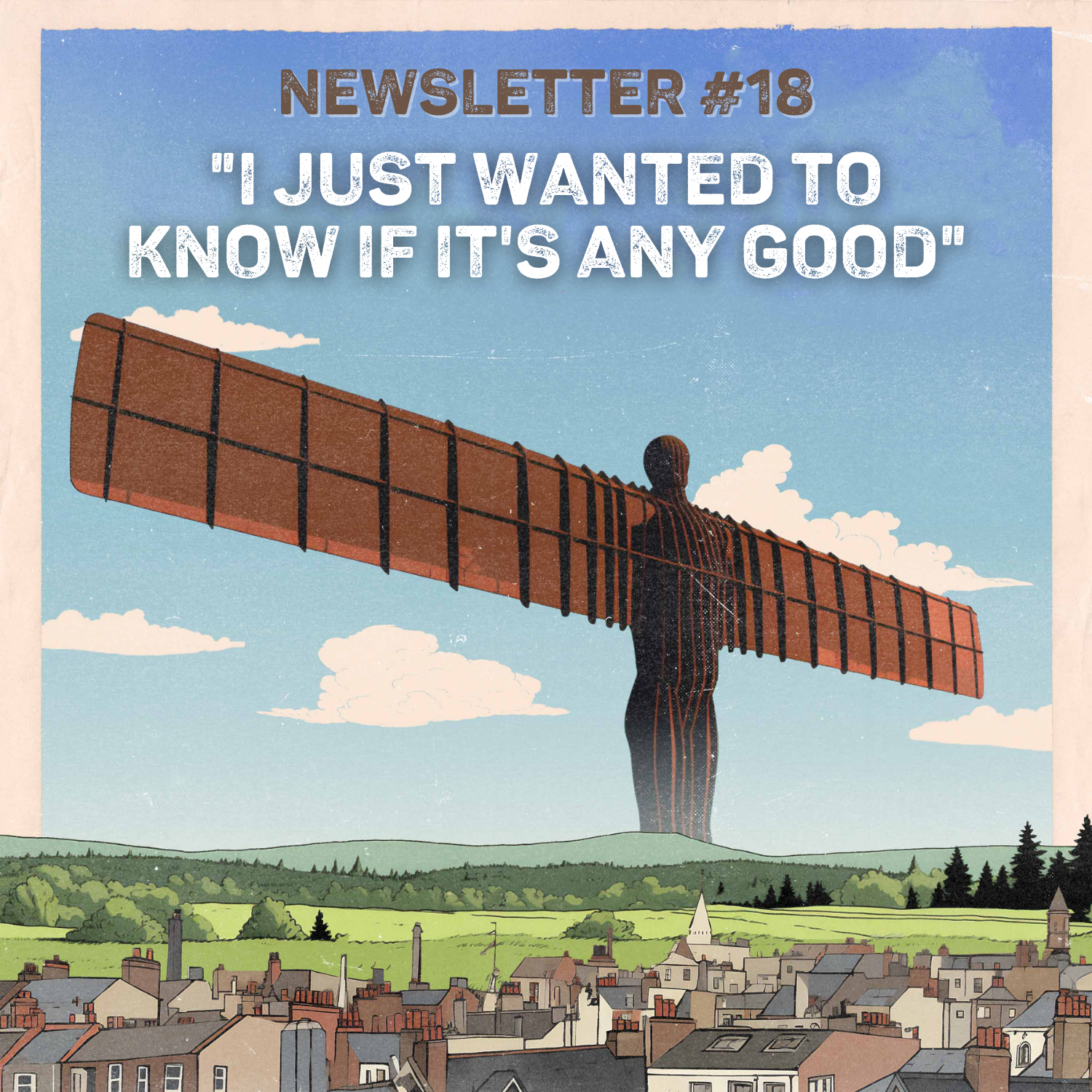
Every year, around 3,000 people from across the north of England submit their writing to the Northern Writers Awards. Most have never been published. Some have never shown their work to anyone. Claire Malcolm MBE, who runs the awards through New Writing North, says her favourite moment is meeting the ones who tell her: "I was just writing in my bedroom. I submitted this because I just wanted to know if it's any good."
They find out it is. Almost every week, one of those writers lands a book deal or finds an agent. The awards have been running for 26 years. But the fact that so many people are writing alone, unsure whether what they have is worth anything, and more often than not filled with self doubt and anxiety about the prospect of sharing their work, tells you something about who this country encourages to write and who it leaves to work it out for themselves.
Claire has spent nearly three decades working on that problem. She founded New Writing North in 1996 and has built it from a small startup into a nationally recognised organisation shaping opportunities for writers across the north of England. She has just raised £10.5 million to build a Centre for Writing in Newcastle. And she has done it inside an industry that has, for most of its history, operated as though talent only exists south of Watford.
Low Sets for English
Claire grew up working class in York. Her family read but they did not own many books. The local library did what libraries do: it opened everything out. She read widely, indiscriminately, things that were far too old for her. She grew a passion for books that has not left her. But at school, because she was a bad speller, she was placed in low sets for English. The books she covered during her school years, she didn't enjoy. Nobody thought she was good enough to study the subject she cared about most. Nobody in her family had been to university. She ended up doing a fine art degree because she had skirted English entirely.
In 1996 she came to Newcastle, where a group of writers had been dreaming about an organisation that would get them work and build profile for northern writing. Everyone she knew in Leeds was heading to London. When she announced she was going to Newcastle, the reaction was unanimous: why would you do that?
She came anyway. And decided to "put it on the map."
"Very Northern"
For the first twenty years, New Writing North was about building bridges to London. The publishing industry is concentrated there. The agents are there. The deals are made there. If a northern writer wanted a career, they needed access to that world, and Claire's job was to provide it.
It worked. New Writing North became known for finding and developing talent. Publishers trusted their judgement. But Claire reached a point where she started asking a different question: we are supplying London with brilliant writers but where is the investment coming back?
Publishing is staffed by lovely people, but they are a certain class of person from a certain part of the country, and that shapes what gets taken seriously, Claire notes. She tells the story of Benjamin Myers, a writer from Durham who sets his novels in West Yorkshire. Brilliant prose interwoven with a specific sense of place. When his early work reached London publishers, the feedback came back: yes, we read it. But Very Northern.
Claire's frustration is precise. She can sit in Newcastle and read a novel set in London or Liverpool or Scotland without thinking it exotic. But a publisher in London reads about Hebden Bridge and finds it insurmountably difficult. There are layers of prejudice wrapped up in that, an assumption that working-class people in the north do not read enough to be a market, and that northern stories are too marginal to travel.
But Ben Myers would go on to prove them wrong. His novel The Offing, set along the coast from Durham to Whitby, was the second biggest-selling book in Germany the year it came out. Ben was born in Durham and proved, very much like our previous guest, Ann Cleeves, that great stories export no matter their origins. The industry just has not built the infrastructure to support that from the north.
One in Five
One in five schools in the North East has a school library.
I had to read that twice when Claire said it. One in five. In a region where book ownership among children is already lower than the national average. Where educational outcomes are among the worst in the country. Where the causes are tangled up with poverty and lack of access to money and everything else we talk about on this podcast.
This year is the National Year of Reading, because the country is in a reading crisis. But Claire makes the point that it is not just children who have stopped reading. Adults too. The attention economy, technology, the sheer noise of daily life, all pulling people away from the one thing that research consistently shows builds empathy, communication, confidence, and aspiration.
Claire's own story is the proof. Books were, as she puts it, "the steps out of the place I was from." She was reading about people who went to university, who lived in London, who did interesting things. She did not know how to get to any of those places. But the books built the idea that different ways of living existed. That matters. If you have never seen a route, you cannot take it.
I think about that a lot in my work at Citizens Advice Gateshead. The people who come through our door are not lacking intelligence or ambition. They are navigating systems that were never designed to be navigated without help. Literacy, in the broadest sense, the ability to understand, communicate, and advocate for yourself, is the foundation of all of it.
When you strip away the library, the books in the home, the teacher who takes you seriously, you are not just closing a door to writing. You are closing a door to everything that comes after it.
The Centre for Writing
Claire is done just building bridges to London. She is building something here. New Writing North has had an offer accepted on a building in Newcastle. The public sector, Northumbria University, and the new combined authority, with strong backing from Mayor Kim McGuinness, have committed £10.5 million. The Centre for Writing will be a physical home for writing and publishing in the north of England, and it is intended to change who gets to write, where publishing happens, and what stories are told.
It is already starting. Hachette UK, the second biggest publisher in the country, has opened a Newcastle office with 20 staff, drawn by what New Writing North has been building. Together they have launched an MA in publishing with Northumbria University.
The Centre is due to open in early 2028. It will have an audio studio, workspace, event space, and a base for the programmes that New Writing North already runs across the region, from the Northern Writers Awards to the skills programmes in libraries, the work in schools, and the deep, long-term partnerships in communities where writing has never been seen as something that is for people like them. We talked about a lot more than I can fit here, AI and what it means for writers, the working-class voices magazine The Bee, screenwriting in the north, what Claire is reading. You can hear all of that in the full episode.
The Confidence It Built.
And finally, I could not close out this newsletter without talking about some of the stories Claire told me about New Writing North's community work, including a poetry project at Excelsior Academy in Newcastle's West End, where they have been working for over a decade.
A young woman called Tessie took part. She was brilliant. They made a video of her performing. Years later, Tessie got in touch. She had not become a poet. She had become a corporate lawyer. She wrote to say that she probably would not have gone to university without that intervention in her school. The confidence it built. The aspiration it unlocked.
On the New Biggin estate, a man with addiction problems started coming to the Tuesday afternoon writing group. He went back to school to do his English GCSE. A woman who had barely been leaving the house since COVID got a job as a dinner lady at the school where the sessions were held.
None of them became published writers. That is not the point. The point is that someone showed up, took them seriously, and gave them a reason to believe their words mattered. Claire has been doing that for nearly thirty years, from a region the publishing industry spent most of that time ignoring. She started with a group of writers who wanted to be taken seriously. She is finishing with a building, a publishing pipeline, and a changed landscape.
One in five schools in the North East has a school library. Four in five do not. Not just primaries. All schools. The government has since pledged a library for every primary school in England by 2029. It is a start. Claire was a passionate reader placed in low sets for English because she could not spell. The question was never about spelling. The issues around a decline in libraries were never about books. Invest in people and they will find their place.
Until next time,
Alison
Listen to the full episode with Claire Malcolm: Spotify | Apple Podcasts
Further reading and resources:
New Writing North
The Bee Magazine: Online, free, working-class voices in writing and culture
Northern Writers Awards: Applications open annually
The Working Class Library Podcast (via New Writing North)
Listen to the This is the North podcast catalogue: Spotify | Apple Podcasts
If you enjoyed this newsletter, please like, share and subscribe. It takes less than 10 seconds and makes you part of something essential: a community of people who believe transformative conversations can become catalysts for positive change.
This is The North Podcast is your source of transformative conversations. An intentional challenge to the systems holding back the North of England. Hosted by Alison Dunn, an award-winning charity chief executive and former solicitor. This podcast is supported by the Society Matters Foundation.
A deep dive into the archive…
This month’s episode of This is the North featuring Claire Malcolm MBE reminded me of all the great authors we’ve featured so far in the series, including Grace Blakeley, Ann Cleeves and Richard O’Neill, all great episodes and worthy of another listen.
This week I have been listening to…
Another great series produced by BBC Radio 4, entitled Currently, About the Girls: The Puberty Puzzle. Young girls are entering puberty earlier than ever and scientists are racing to understand why. The research is ongoing, but there’s a suggestion the issue may be linked to the growing problem of obesity, suggesting there’s a link between the body fat percentage of young girls (which is on the rise) and the message this send to the brain to begin the process of puberty.
This month I’ve been reading…
The Financial Feminist by Tori Dunlap, in which she investigates the financial literacy and wealth gap between genders. It takes a bit to get past some of the Americanisms, but once you do, this is an informative read. It raises a big red flag for women and girls everywhere, namely that girls are significantly less likely to receive a holistic financial education; they’re taught to restrain spending, while boys are taught about building wealth and rewarded for pursuing it. As the narrative unfolds, Dunlap believes that in adulthood, women are hounded by the unfounded stereotype of the frivolous spenders whose lattes are to blame for the wealth gap, and she tells us that when something like, say, a global pandemic happens, women are the first to have jobs cut and the last to re-enter the workforce.
The topic of gender inequality and financial feminism both fascinate me, not least because some of the childhood conditioning she describes in her book, the stuff that moulds how women and girls think about money and risk, these things were very obvious in my own childhood, and I am writing about this very thing in my upcoming book, Friend or Foe? It’s also a very good reason to record a future episode of This is the North with the CEO of Develop North, Michelle Percy.
Michelle joined Develop North, an investment company, as recently as January 2026, and she has a strong ambition to use her platform to regenerate the region. Michelle and I met earlier this week to talk about all things money, and turns out she’s concerned about the lack of female investors too, so we thought we’d talk it out on the show. More to follow!
This month I’ve been visiting…
Seems Manchester is the place to be, I’m not surprised, it’s a great city, and if I ever were to move out of Newcastle, this is where I’d likely end up. Two visits to Manchester this month, firstly to the Culture Shift Conference to participate in a panel discussion about how employers can better respond to harmful behaviour in the workplace, such as bullying, harassment or discrimination. Whilst I was there, I had the opportunity to hear from some fabulous speakers on workplace culture, but the two that stood out for me were Ameera Jamil, co-founder of Re-cultured, who talked with such passion and authority about honour violence and Harriett Smailes of Leicester University, who specialises in research on sexual violence and domestic abuse. Harriett talked about the growing use of strangulation during intimacy, something I’ve been researching a lot recently as I develop the manuscript for my book ‘Friend of Foe?’.
My second trip to Manchester involved a two-day conference hosted by a great organisation called Resolve, which brought together policymakers, practitioners and leaders from across the UK to explore how local and regional action can tackle poverty in the context of national policy developments, including the Child Poverty Strategy. Across two days, the conference focused on the vital role of localities in delivering practical interventions that maximise household incomes, a foundation for building good lives, particularly for children and young people. Discussions connected the anti-poverty agenda with unlocking the potential of people and places. I met so many great people, had some good conversations and learnt a lot – my thanks to Resolve for such a great event. I’m already looking forward to next year.
Where are we with the book?
Well, it turns out writing a book is a mighty time-consuming thing. Thankfully, it’s incredibly rewarding, and you get to meet lots of interesting people and learn lots of new stuff, but it takes way more time than you can possibly imagine!
I’m pleased to say that the current draft sits at about 24,000 words out of a target count of about 40,000, so we are more than halfway with almost 12 chapters complete, to include one on financial feminism (no spoilers there – see above!). You can find out when the book is about to be launched by clicking on this link. Your details will be used responsibly, and you will not be mercilessly spammed – I promise, I’m far too busy for that.