Welcome to the seventeenth edition of the This is the North podcast newsletter.
"If I'd Known That, It Would've Affected My Vote"
By Alison Dunn, with insights from Sarah Breeden.

At a citizens' panel in London's East End, a Bank of England official sat down with a group of local residents to talk about how the economy works. Interest rates. Inflation. What happens when prices rise and wages don't keep pace. At the end of the session, one woman said: "If I'd known that, that would've affected my vote."
Nobody had ever explained economics to her in a way that connected to the decisions she makes every day. And that gap between economic policy and public understanding is not accidental. It starts with who gets taught economics in the first place.
I recorded this conversation with Sarah Breeden back in October. Since then, a ceasefire in Gaza, a trade truce between the US and China, a war in Ukraine that shows no sign of ending, and now a conflict between the US, Israel and Iran that has disrupted shipping through the Strait of Hormuz.
The Bank has cut rates twice, down to 3.75%, and on Thursday the MPC announces again.
But the question at the centre of our conversation has not changed.
Research published last year by FFT Education Datalab, commissioned by the Bank of England, tracked every student studying economics in England through GCSE, A-Level and degree.
At degree level, 30% of economics students came from London. From the North East, it was 1%.
I spoke to someone from that 1%. Not quite, but close enough.
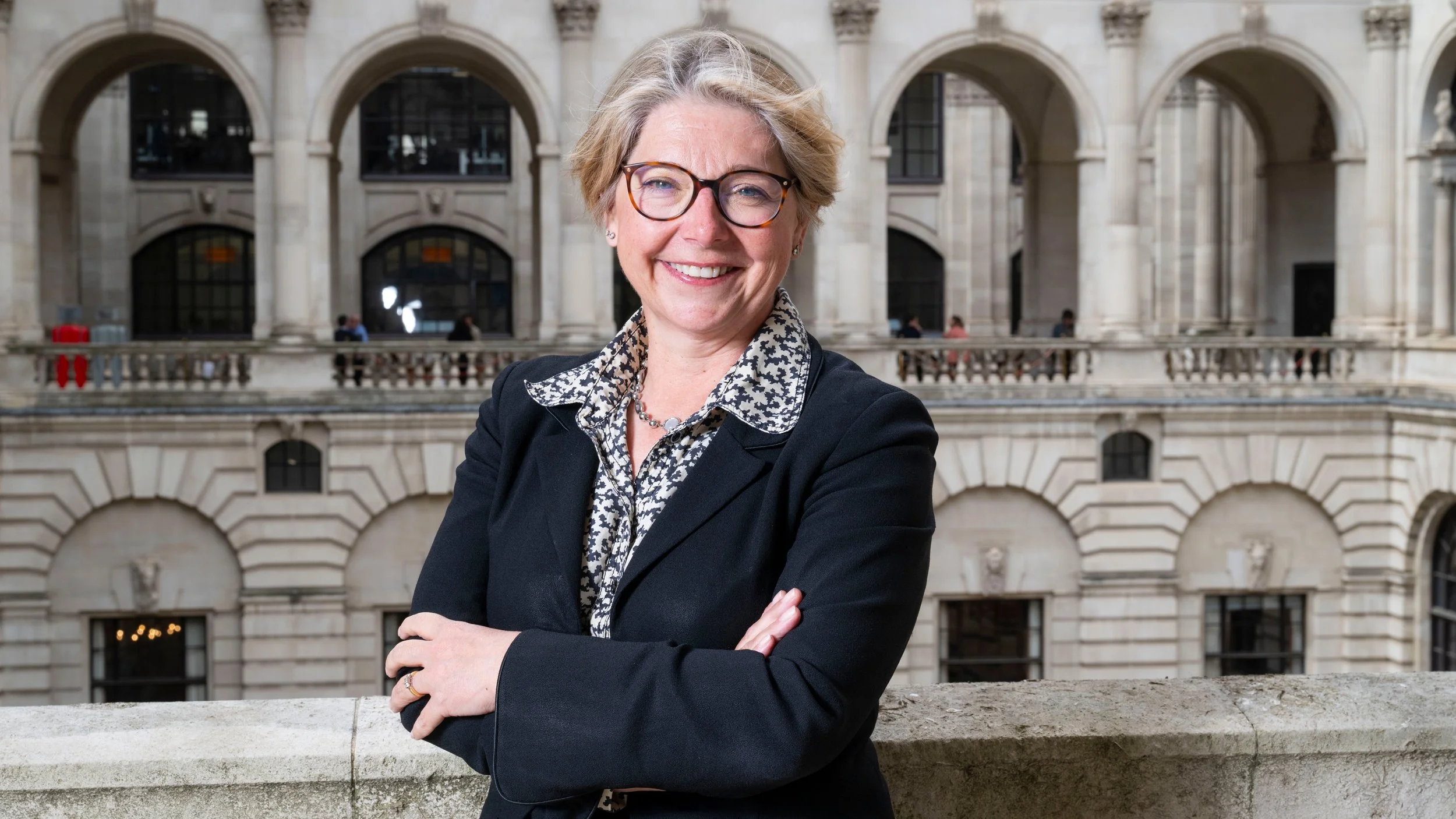
Sarah Breeden grew up in Stockport, went to the local comprehensive, and has spent the last 34 years at the Bank of England. She is now Deputy Governor for Financial Stability, which means when the economy wobbles, she helps decide what happens next. She also sits on the Monetary Policy Committee, the body that sets interest rates for every household and business in the country. Which means Thursday's decision is hers too.
When we spoke, Sarah described her childhood as "bog standard, northern, normal." Mum and dad worked in local government. She went to the local primary, then the comp. She did well at school because she enjoyed it and put the work in.
Before the Bank of England, she spent a summer standing next to a conveyor belt at Manchester Airport putting parsley on airline meals. She worked in a pub. She did market research, office administration, and shifts at the local council. The connecting thread, she says, was a work ethic instilled by her parents: "That Protestant work ethic, as I used to call it."
When I asked what she left Stockport with, her answer was two things: that work ethic, and a commitment to public service. "Not for money. Because it makes a difference."
Thirty-four years later, she is one of six people in the Bank's senior leadership team. Three of them are now women.
She founded the Bank's internal women's network in 2007 and co-chaired it for eight years.
The senior team is now 50/50. But she is honest that the layer below is not bringing women through at the rate she had hoped. Progress at the top does not mean the pipeline is fixed.
That is true of the Bank's gender balance. It is even more true of its geography.
Four Pints of Milk
Ask Sarah what keeps the public awake, and the answer comes quickly: food prices.
She knows it because the Bank measures it, and because she hears it directly when she visits communities across the UK. When we spoke in October, food inflation was already running above the headline rate. By January 2026, it had reached 3.6% according to the ONS, higher than overall inflation at 3.0%. At its peak in March 2023, it hit 19.1%, the highest rate since 1977.
Sarah describes Britain as "a small open economy," one that imports 40% of its food but no longer determines the price of anything on the world market.
"We are a recipient of," she says.
What is happening in the Strait of Hormuz is not a foreign affairs story. It is a food prices story.
And so, anyone who has stood in a supermarket doing the maths on four pints of milk, a loaf of bread and a pack of mince already knows: the prices on the shelf are not coming back down. Prices increase, wages stagnate and something has to give.
That is the thing people struggle to accept, and Sarah explains it more clearly than most economists I have heard: if you knew prices would be cheaper tomorrow, you would stop buying today. Enough people doing that, and economic activity collapses into a downward spiral. "That's why our target is 2%," she says. "Low and stable. Not zero."
It makes sense when you hear it explained. But knowing why prices won't fall doesn't make the weekly shop any easier. I see it every week at Citizens Advice Gateshead, people from all kinds of backgrounds walking through the same door, dealing with the same squeeze. The cost of living crisis isn't over. It just stopped making the front page. The Bank has cut rates since we spoke, but easing is not reversing.
Sarah and her colleagues spend weeks each year visiting businesses around the country, Cardiff one week, Newcastle the next, listening to what is actually happening to sales, wages, hiring, prices. That intelligence feeds directly into interest rate decisions, including whatever is announced on Thursday.
The Missing 99%
The thing I kept coming back to after we finished was this: the decisions made at the Bank of England affect every household in the country. So who is in the room when those decisions get made?
The FFT Education Datalab research is stark. Economics A-Level is offered in just over half of non-selective state schools in England. In selective schools, it is 90%. In independent schools, 82%. The subject is available to children whose families can afford to choose where they go to school. For everyone else, the subject doesn't exist.
Think about what that means in practice. A seventeen-year-old in Blyth picks their A-Level options and economics is not on the list. Not because they would not be good at it. Not because they are not interested. Because nobody thought to offer it.
Sarah sees this from both sides. She was on the phone to Northern Rock directors as the queues formed outside, she knows what happens when the system breaks, and who pays first. She is proof that a girl from a Stockport comprehensive can end up setting interest rates. But she also knows she is an outlier. The pipeline that produced her barely exists for the generation behind her. (The Bank's other Deputy Governor, Clare Lombardelli, also grew up in Stockport. Two of the most senior economic policymakers in the country from the same Northern town. Given the pipeline, the odds of that are almost absurd.)
The Bank knows it has a problem. It is building a permanent expanded office in Leeds, with a target of 500 staff by 2027. It has people working routinely from Newcastle. But progress has been slower than planned, and the institution is now directing half of all new external hires to Leeds to close the gap.
Moving jobs to Yorkshire is welcome. But if economics is not taught in the schools where Northern children actually are, the Leeds office will be staffed by people who moved up the M1, not people who grew up beside it.
The Bank's new teacher training programme with the University of Manchester is a start: training existing teachers to deliver A-Level economics alongside their core subject, beginning in the North West and expanding to Yorkshire and the North East over three years.
Twenty-five places in year one.
Twenty-five. Against a regional population of fifteen million.
The door does not slam shut. It was never open. Not to economics in our schools, not to the forces that set the price of our food, and not to the decisions that shape our lives.
Change starts, frankly, with us.
Until next time,
Alison
Listen to the full episode with Sarah Breeden: Spotify | Apple Podcasts
Listen to the This is the North podcast catalogue: Spotify | Apple Podcasts
If you enjoyed this newsletter, please like, share and subscribe. It takes less than 10 seconds and makes you part of something essential: a community of people who believe transformative conversations can become catalysts for positive change.
This is The North Podcast is your source of transformative conversations. An intentional challenge to the systems holding back the North of England. Hosted by Alison Dunn, an award-winning charity chief executive and former solicitor. This podcast is supported by the Society Matters Foundation.