Welcome to the fifteenth edition of the This is the North podcast newsletter.
The Stories We Keep
By Alison Dunn, with insights from Richard O’Neill MBE.
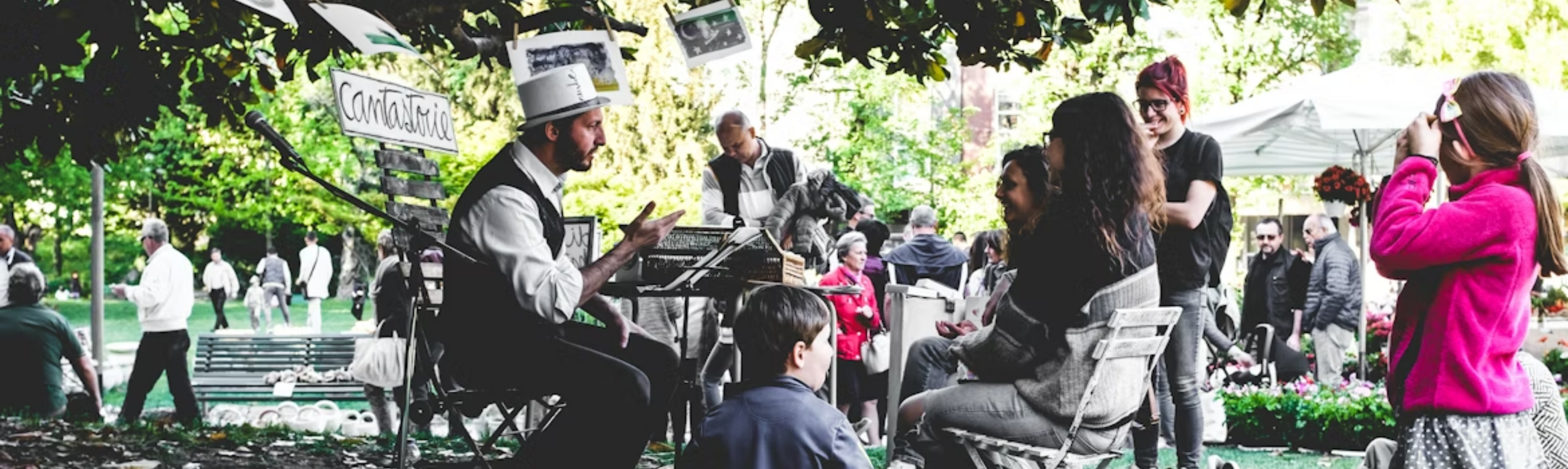
Photo courtesy of Unsplash
Recently, I sat down with Richard O'Neill MBE, storyteller, author, playwright, Professor in Practice at Durham University, and someone who grew up in a traditional Romani traveller family right here in the North East.
I'll be honest, I thought I knew what this conversation would be about. Storytelling. Oral tradition. The importance of keeping culture alive. Yet what Richard taught me was something I hadn't expected. His family weren't just travellers. They were story keepers.
For hundreds of years, Richard's family travelled to this region. Newcastle to Yorkshire to Carlisle and back again. Working fields, breeding horses, buying and selling. Every winter, they'd settle on Scotswood Road with their old wagons and cars, listening to stories from people in the villages and towns, then passing those stories on as they travelled. Sometimes even passing them back the following year to the very same people.
These were people who couldn't read or write in the conventional sense. But in terms of communication? Incredibly literate.
"They would pass on everything through storytelling," Richard told me. "Our history, our sense of belonging. Everything was passed on in stories."
"In Newcastle, you might say, 'gadji?'" Richard said.
I nodded. I've said that. I've heard that my entire life.
"The word gadji comes from gadje, which is Romani for a non-Romani person. And when we say chaff or chavi, that comes from the Romani word chav. Chavi means a boy, chavi means a girl."
I had no idea. None. Dozens of words in the way I speak, the way my family speaks, the way people across the North East speak come from Romani.
Richard told me about a musician friend from outside the region who came to Durham for work. They went to Morrisons together. Richard got in the queue first and started chatting to the person at the checkout. When they got in the car afterwards, his friend asked, "How long have you known her?" "I've never met her before," Richard said. His friend couldn't grasp it. The concept of just having a chat, even whilst you're getting a few bits and pieces in the supermarket.
"We are story people here," Richard said.
And he's right. We are. I do this. You probably do this. We chat at bus stops, in queues, on street corners. People from other places find it baffling. The North East has a warmth and rhythm to our speech, a musicality that makes conversation feel different. It's not an accident that we're the call centre capital of the UK.
The most powerful story Richard tells, to children and adults, is about one of his relatives, a First World War veteran.
During the Second World War, when he was too old to serve but had two sons in the army, he went into a shop he'd frequented for years. He was a woodcarver. The shop had a new owner. Who refused him service. He came back to where his family was camped and told his wife. She was furious. She wanted to confront the shop owner. But he'd had such an experience in the First World War that he was a totally peaceful man. He didn't want any upset. A woman came up and asked if he could make a wooden toy for her son. Her husband, the boy's father, was in the army and it was the child's birthday. He said yes. Afterwards, his wife asked, "Why did you offer to do that for that woman when they treated you like that in the shop?" He said, "Because it wasn't they. It was one person. And if I treat that woman the same way I've been treated in that shop, I'd be as bad."
When Richard told me this story, I felt it land.
"Children totally get it," he said. "Because every person has in some way been judged."
Richard works at Seven Stories in Newcastle, the National Centre for Children's Books, teaching storytelling to teachers and children. He told me about a storytelling event at a care home that integrates a nursery with elder care. The youngest child was three years old. The eldest resident was 103.
"They were laughing along at the same things," Richard said.
Richard believes teaching children how narrative works is how we combat misinformation. Because for a story to work, it needs certain elements.
"When you're telling that story to a group of people, they're not gonna let you get away with it," Richard said. "'No, you're wrong. It was a red lorry, not a black lorry.'" The audience holds you accountable. The community keeps the story true. AI can amalgamate what already exists. But it can't be held accountable by a three-year-old who knows when something's wrong.
"I think AI is the new steam," Richard said. Whether that's true or not, only time will tell. But what I know for certain is this: no AI is going to teach my grandson to see one person instead of they. That takes a story. That takes a human voice. Richard's family were story keepers. But what I realise now is the stories keep us just as much as we keep them. They turn strangers into neighbours at checkouts and bus stops across the North East. They teach a three-year-old and a 103-year-old to laugh at the same things. They show us how to choose compassion when we've been treated with cruelty.
Richard's full conversation explores his journey from traveller family to professional storyteller, why he refused a million pounds to appear on exploitative TV programmes, and how the North East became one of the great storytelling cultures.
2026 is the National Year of Reading, and Richard's work at Seven Stories reminds us why that matters. Reading doesn't just teach us words, it teaches us to listen for the truth in a story, to hold each other accountable, to see one person instead of they.
I'm still saying gadji without thinking about it. But now I know what I'm keeping alive when I do.
Until next time,
Alison Dunn
Learn more
Seven Stories (National Centre for Children's Books, Newcastle) - sevenstories.org.uk
Listen to the full This is the North podcast:
> Spotify
> Apple Podcasts
If you enjoyed this newsletter, please like, share and subscribe. It takes less than 10 seconds and makes you part of something essential: a community of people who believe transformative conversations can become catalysts for positive change.
This Is The North is your source for transformative conversations that challenge systems holding back the North of England. Hosted by Alison Dunn, supported by Society Matters Foundation.
A deep dive into the archive…
If there’s one thread that runs through this month’s reflections, it’s the extraordinary power of story — to connect, to persuade, to educate, and sometimes to confront.
There’s no question over the credentials of Richard O’Neill MBE as a spellbinding storyteller. Listening to Richard reminded me that storytelling isn’t simply about entertainment. It’s how human beings make sense of complexity. It’s how ideas travel. It’s how difficult truths are heard.
That thought took me back to a conversation from the archives with Lord Richard Harrington (Episode 27), where we explored the subject of foreign investment. On paper, that can sound dry, technical, even impenetrable. But through story, it became something entirely different.
From the son of a Leeds market stall holder to Oxford scholar, successful entrepreneur, Member of Parliament and ultimately a life peer in the House of Lords, Lord Harrington’s journey embodies transformation and resilience. Through candid, humorous and often self-deprecating recollections, he made policy human. He reminded us that behind every economic strategy are people, risks, setbacks and bold decisions. It’s well worth another listen.
This month I’ve been to see…
This month I had the joy of attending Sunday for Sammy, and if you were there too, you’ll know just how spectacular it was.
Surprise appearances from Sting and Lewis Capaldi, alongside Matt Healy and a host of new and emerging artists supported by the charity, made for an unforgettable night. And then that show-stopping finale: the whole arena, united in voice, singing Run for Home by Lindisfarne.
Storytelling doesn’t only live in conversation, it lives in music. In shared experience. In collective memory.
I was lucky enough not long ago to interview Ray Laidlaw, who produces the Sunday for Sammy show. Seeing Ray on stage, still doing his thing, was genuinely magical. His episode of This is the North is another reminder that cultural legacy is carried not just in archives, but in people. If you missed it, you can catch it here.
This month I’ve been listening to…
This month I’ve also been listening to Word of Mouth on BBC Radio 4, focusing on Tourette Syndrome.
In conversation with Lone Georgakis, Therapies and Advocacy Manager for Tourette Action, what struck me most was her candour and positivity in describing her own experience. Tourette Syndrome can be devastating for those who live with it — not simply because of the condition itself, but because of misunderstanding and stigma.
Through personal testimony, the conversation moved beyond symptoms and into lived reality. It demonstrated again that when we tell stories well, we replace assumption with empathy.
It’s well worth a listen.
This month I’ve been reading…
Stories That Confront, a book called Rough by Rachel Thompson.
In Rough: How Violence Has Found Its Way into the Bedroom, Rachel recounts the experiences of more than 50 women and non-binary people, exposing how sexual violence has been normalised and reframed within contemporary culture.
This is not an easy read, nor should it be. What makes it powerful is not only the research, but the stories. The voices. The patterns that emerge when individual testimonies are placed side by side. The book lays bare how systems of oppression, rooted in patriarchal structures, seep into intimate spaces, shaping expectations, behaviours and ultimately harm. And it reminds us that the consequences of violence do not end in the moment; they ripple outward, shaping confidence, relationships, opportunity and wellbeing long after.
The Thread That Connects It All
From economic policy to live music, from neurological difference to confronting sexual violence, the common denominator is story.
Stories translate complexity.
Stories build empathy.
Stories challenge power.
Stories create belonging.
And perhaps most importantly, stories make change possible.
This month’s archive deep dive is a reminder that whether we are talking about investment strategy, charity fundraising, health advocacy or cultural critique, facts inform, but stories move and that’s the joy of making this podcast and writing this newsletter, the opportunity to tell and to hear great stories, because when stories move us, they move society and that’s my goal, a kinder, more inclusive and thoughtful discourse that informs and sometimes shifts the dial.