Welcome to the thirteenth edition of the This is the North podcast newsletter.
Britain’s Hidden Crisis
What happens when the system designed to support families actively works against them?

By Alison Dunn, with insights from Amanda Bailey, Ang Broadbridge, and Dr. Steph Scott
Photo of Newcastle Quayside by Juliette Herlem courtesy of Unsplash

Recently, I sat down with Amanda Bailey from the North East Child Poverty Commission, Ang Broadbridge from Ways to Wellness, and Dr. Steph Scott from Newcastle University to discuss their research on childcare in the North East.
One finding captures everything that's broken about our system: parents described feeling "punished for wanting to work."
In 2025, in one of the wealthiest nations on earth, parents feel punished for trying to provide for their families. That's not an accident. That's been the chosen policy, until now.
A Moment of Progress, And A Question
We recorded this conversation just days before the Autumn Budget, when the two-child benefit cap still affected 70,000 children across our region. Nationally, 4.5 million children live below the poverty line (a record high), with the two-child cap as one of the single biggest drivers.
The government has since scrapped this punitive policy, a decision I've long supported through my organisation, and I want to acknowledge this significant step forward.
But why did it take this long? And more importantly: when we look at other nations that treat childcare as essential infrastructure rather than a luxury, what else are we still getting wrong?
“Childcare is infrastructure. It is economic policy. It is gender equality. And it is social justice.”
When Infrastructure Becomes Invisible
We talk about infrastructure constantly i.e., roads, broadband, transport links. But childcare? As Amanda put it, childcare is "essential infrastructure" that should support families to work, improve children's development and school readiness, and provide quality employment for thousands.
Yet unlike other infrasture, child exists in the shadows.
There's little regional research on it, and what we do know changes almost yearly as new policies get bolted onto old ones, creating a maze that even the most capable parents struggle to navigate.
The North east has some of the country's lowest wages, yet our childcare costs sit somewhere in the middle nationally. Some parts of our region have five times the average ratio of childcare places to children, while other areas have some of the lowest coverage in England.
Postcodes determine whether you can afford to work. That's the infrastructure we've built.
The Juggle That Never Ends
Their research explores what cost figures miss: the emotional and mental health burden that childcare places on families.
Ang spoke about one participant, Joanne, who'd given up work entirely and was dependent on her partner's wage and her mother providing childcare. The description of her mum 'moaning all the time' wasn't about inconvenience, it was about the strain on family relationships when something is both a favour and a financial necessity.
Their research revealed parents experiencing constant guilt, damned if they work, damned if they don't. Relationships strained across generations. Grandparents shouldering caring responsibilities they never anticipated. And beneath it all, a persistent anxiety about whether they're coping, whether they're good enough, whether asking for help might draw unwanted attention from others.
This isn't about money alone. It's about identity, dignity, and the psychological weight of a system that seems designed to make everything harder than it needs to be.
In our own family, we experience this directly. My grandson has special educational needs, and finding any childcare (breakfast clubs, afterschool clubs, holiday provision) is virtually impossible. My daughter, like so many others, cobbles together an informal arrangement across the extended family. We each take annual leave days to cover school holidays between us. We can do that. We're fortunate. But not everyone has that safety net.
The Complexity Trap
Amanda walked us through the bewildering array of schemes available: the 15 hours for two-year-olds in low-income families, the 15 hours for all three and four-year-olds, the 30-hour scheme from nine months (but only if you're earning a certain amount), tax-free childcare, the childcare cost scheme through Universal Credit, free breakfast clubs, afterschool support…
As she listed them, I found myself exhausted just listening. And I work in this field.
Your eligibility depends on your children's ages, your working status, your income, the time of year, and whether you can access digital services. And that's before you even get to: are there actually places available in your area? Do they fit your working hours? Can they accommodate your child's needs?
As Amanda put it, "If you were starting from scratch with a blank piece of paper, you certainly wouldn't design this system."
For families living in poverty, accessing childcare and being able to work becomes what the research describes as a 'chicken or egg' scenario. Parents need to already be in employment to access the childcare provision that they need to be able to take up employment in the first place. The trap is obvious. The solution isn't.
The Sector Under Strain
We cannot talk about childcare without talking about the people who provide it. Their research revealed childcare staff who are often in very similar financial positions to the families they support. Several providers the team spoke to even have food banks on site.
As one provider told them: "We pay people more to care for our coffee than we do to care for our children. Our staff could earn more working in Costa."
The emotional toll on providers comes through clearly in the research.
Staff flagged delays with referrals to other services that compounded the level of support they had to provide. They described having to offer extended support, providing refreshments for struggling parents, stretching opening hours, signposting to further help.
Nursery managers outlined acute barriers to recruiting and retaining staff. All acknowledged crucial gaps in knowledge and skills around particular communities and needs: working households experiencing 'hidden' poverty, SEND, high medical need and cultural diversity. The providers see the dysfunction clearly. The families live it daily. The evidence documents it comprehensively. The question is whether policymakers will act on it above simply scrapping a cap.
What Happens Next
Their research makes four clear recommendations, and I want to highlight them because they represent a roadmap for genuine change:
First, we need a more joined-up approach to understand and support families with the interrelated issues of childcare and economic activity. Benefits systems which prioritise workforce participation regardless of whether work hours fit around caring responsibilities must be carefully scrutinised.
Second, we need a specific sufficiency and impact assessment of childcare in the Northeast. Current local authority assessments lack evidence of impact, quality, and detail about whether provision meets objectives, particularly for children and families with additional needs.
Third, greater emphasis should be placed on the value of formal childcare provision for school readiness and educational support, not just enabling parents to work. The economic arguments are strong, but the additional value to child development is often overlooked.
Fourth, we must recognise that childcare is a key employment sector, particularly for women. Provider pay should be increased to aid staff retention, improve availability and support quality provision.
A Vision Worth Fighting For
Now, as you read this or tune into the podcast, I understand that there will be people out there who will say you simply shouldn't have children if you can't afford them. That as a nation, we simply cannot afford to maintain the recent removal of the two-child benefit cap or expand childcare provision further.
Let me put this in perspective.
The two-child benefit cap cost roughly £3 billion annually to scrap. Last year, the government said this was money we simply didn't have. Critics argued it was fiscally irresponsible. Conservative leader Kemi Badenoch has vowed to bring it back if her party returns to power. A reminder that progress can be reversed as easily as it's won.
Yet child poverty costs this country an estimated £39 billion every year in health costs, educational support, lost economic productivity, and the long-term social impacts that compound across generations.
£39 billion. That's not a policy trade-off. That's a false economy.
As Amanda noted during our conversation: 'The cost of doing nothing, both for individual children and families and for our region and country as a whole, is far greater than the cost of the policies we need.'
The scrapping of the two-child benefit cap is progress. It will “lift around 350,000 children out of poverty”, including 70,000 right here in our region. We can recognise movement while refusing to accept that movement alone is sufficient.
Yet as we've recently outlined in the Society Matters Foundation white paper on childcare reform, this isn't about fixing a broken system alone, it's about recognising a fundamental truth:
'Childcare is infrastructure. It is economic policy. It is gender equality. And it is social justice.'
Extending the current 30-hour entitlement from 38 weeks to 52 weeks for example, would require £2.4 billion but generate returns of £8.2 billion. Meanwhile, places like Quebec and Sweden prove what's possible when childcare is treated as essential infrastructure rather than luxury.
Both the research and our white paper point toward questions we need to answer, not just problems we need to acknowledge. What would Quebec's model mean for a family in Gateshead? How would a single parent in County Durham navigate Sweden's system? How do we adapt international successes to Northern England's particular challenges? These aren't academic questions, they're essential to understanding what transformation actually requires.
For too long, struggles around childcare have been treated as individual failures rather than systemic problems. Parents have shouldered guilt, fatigue, and anxiety in isolation, believing they should somehow be managing better. The system is broken. Not the parents trying to navigate it.
As Amanda observed, childcare should hit multiple policy buttons, supporting families to work, improving children's outcomes, and providing quality employment. Right now, it's failing on all counts.
We have parents who feel punished for working and exhausted from navigating a system designed to defeat them, children missing opportunities for development, and a workforce struggling to survive. That's not infrastructure built for a nation to grow and thrive.
The real question isn't whether we can afford to invest in children and families. It's whether we can afford not to. This hidden crisis has lived in the shadows long enough. Childcare must move from invisible burden to visible priority. From crisis to infrastructure we can build upon. Amanda, Ang, and Steph have given us the evidence. The cap removal shows change is possible. Research shows how much further we need to go. We can do better. We must do better. Because as a society, we will be judged not by our rhetoric about supporting families, but by whether children can actually thrive regardless of when they were born or what challenges their families face.
Until next time,
Alison Dunn
Read the Research
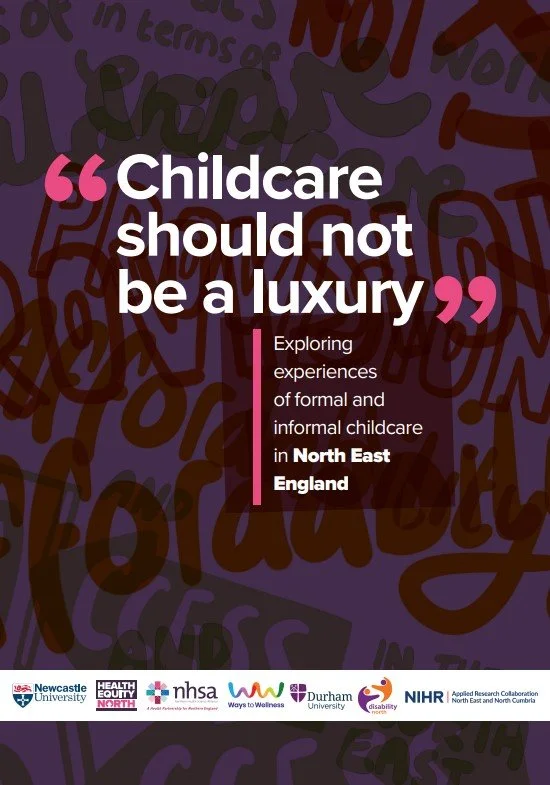
"Childcare should not be a luxury": Exploring experiences of formal and informal childcare in North East England - available through Health Equity North
Listen to the full This is the North podcast:
> Spotify
> Apple Podcasts
If you enjoyed this newsletter, please like, share and subscribe. It takes less than 10 seconds and makes you part of something essential: a community of people who believe transformative conversations can become catalysts for positive change.
This Is The North is your source for transformative conversations that challenge systems holding back the North of England. Hosted by Alison Dunn, supported by Society Matters Foundation.

A deep dive into the archive…
Talking to Amanda, Steph and Ang about childcare, I couldn’t help think about my own family situation. Childcare for kids with special educational needs is almost non-existent. My grandson was allocated 2 days of childcare during the six weeks summer holidays, which put enormous pressure on my daughter and her employment. In the end, we solved this problem by each member in our extended family taking a day of annual leave, and between us, we got the job done. However, what our labour doesn’t provide for him is the opportunity to experience a new environment, play with friends, or try new activities. There’s a real lack of understanding and I’m going to be bold and say, a real lack of care, given to families of SEND, and so it was a real pleasure to talk to Charlie Bewick of Our Altered Lives in episode 18 of This is the North when she shared her own experience and how she’s using that to change the world of work.
This week I have been listening to…
The BBC’s Woman’s Hour, and an intriguing conversation about “Why Women are leaving teaching” and surprise, surprise one of the reasons is both the affordability and the accessibility of childcare for a profession where there are long hours and very little flexible working. It really does bring to life some of the themes that Amanda, Steph and Ang talk about in their episode of This is the North.
This month I have been reading…
A lovely little book called “French Windows” by Antonine Laurain. A book originally written in French, it tells the story of a psychotherapist and an enigmatic patient, with a rather deadly twist at the end. I liked this book because within it were several smaller stories that stood on their own as well as within the primary text, but the real draw was its so short but still powerful, a book you can read in a single rainy afternoon.
This month I have been visiting…
The North East Chamber of Commerce Inspiring Female Awards at Newcastle Civic Centre and what a treat it was to listen to all these great women and their fantastic contributions to the North East of England, but what I liked most of all was spending an afternoon with my very own group of inspiring women from across The Society Matters Group – Corinna Fairley-Briggs, Courtney Marshall, Debbie Curry, Emily Watson, Natasha Greaves, Alison Taylor, Charlotte Anderson, Michelle Kolberg and Quynh Nguyen – you all rock! Thank you for all the amazing things you do every single day.