Welcome to the eleventh edition of the This is the North podcast newsletter.
From Empty Boxes to Full Hearts:
When Kindness Becomes a Movement
By Alison Dunn, with insights from Juliet Sanders.
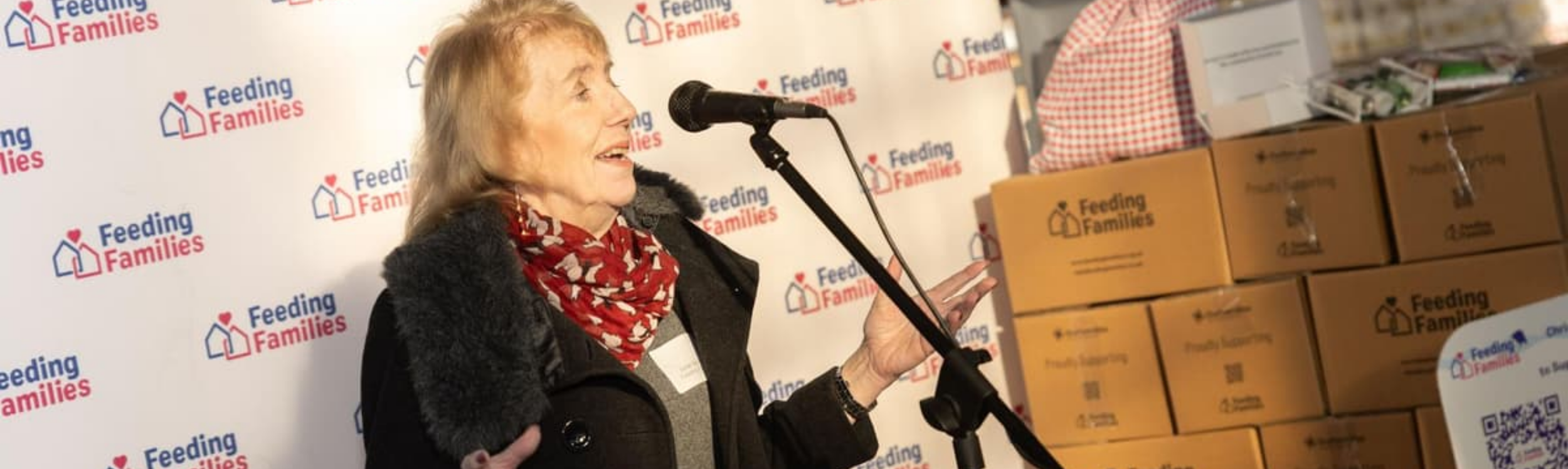
Photo of Juliet Sanders speaking at a Feeding Families event courtesy of Northumberland Gazette
This week on This Is The North, I sat down with Juliet Sanders, founder and CEO of Feeding Families, for a conversation that reminded me why I do this work.
Juliet's journey, which started with two sofas, and ended up feeding tens of thousands and becoming one of the Northeast's most vital charities, is a perfect example of how small acts of kindness, compassion and care, can transform into a positive movement for change simply by beginning with the act of paying it forward.
The Woman Who Wrapped Empty Boxes
It began with sofas. Not good enough to sell, too good to throw away.
Juliet and her husband decided to give them away for free, working through a list of people who'd expressed interest. One woman kept saying, "I really want them. I really want them."
When they finally reached her on the list, she said: "I'm really sorry, I don't have the money for the van."
So Juliet hired one. What they found when they arrived to carry those sofas into a house in Gateshead was five children under seven, and no furniture. Nothing.
The woman shared something with Juliet, that, to be frank, breaks my heart whilst I write this.
This mother of five, wrapped empty boxes for Christmas because she had nothing to give her children. What’s more heartbreaking is she made a game of it, stacking them up, knocking them down.
"We came out of the house and looked at each other and thought, what do we do? We can't just walk away," Juliet told me.
That was 2016. Less than a decade ago, right here in the North East.
“We give without judgement. You are where you are and we want to stand with you and help you.”
When 50 Becomes 719
In response to aid the mother of five, in any way they could, Juliet and her husband spontaneously bought groceries and took them back to her. A couple of weeks later, she tried to check on the family. The phone number was dead. They never saw her again.
But something had changed. "What that sparked in us was how doable it was to make a real difference in somebody's life," Juliet explained, through the simple act of kindness.
The following Christmas, she thought, maybe we could help 50 families. That first year, Feeding Families supported 719.
What strikes me most about this isn't just the scale (though that's remarkable), it's the model.
When Juliet posted on social media asking if anyone needed help, 200 people responded within an hour. But crucially, it wasn't just people asking for help. It was people saying: "If I knew who to help, I would help."
That insight, that communities want to support each other but lack the infrastructure to do so, became the foundation of everything that followed.
The Geography of Hunger
Today, Feeding Families works with 366 partner organisations across the Northeast, from schools, to charities, to community groups. They don't run food banks where people must show up at specific times with vouchers. Instead, they provide food in bulk to trusted partners who know their communities intimately.
This matters more than you might think.
As Juliet explained, traditional food banks require transport, availability during working hours, the ability to obtain a voucher elsewhere first, and often have limits on how many times you can return. "There's a hardcore of people who are just not able to cut it in that way."
The insight about school attendance particularly struck me. A Newcastle school had families they couldn't engage. When they investigated, they discovered children weren't willing to go to school because they couldn't maintain good personal hygiene, leading potentially, as Juliet would note, to those children being bullied and shamed.
In response, Feeding Families provided toiletries and cleaning products. The head teacher reported that children's attendance improved. "If a barrier is a stick of deodorant or a bar of soap, it's such a small thing, but it's such a significant thing if you don't have it." Juliet observed.
This is the invisible architecture of poverty, the compound effects that make escape nearly impossible.
Without soap, children miss school. Without education, future opportunities vanish. Without solutions, real actionable solutions, problems multiply while we debate policy blind to the true realities unfolding around us.
Beyond the Safety Net
What makes Juliet's approach different isn't just the scale (though feeding tens of thousands matters enormously), it's the simple recognition that dignity requires more than calories. Feeding Families now provides culturally appropriate food, particularly halal provisions that other services rarely offer. "We give without judgement," Juliet told me. "You are where you are and we want to stand with you and help you."
They've also begun piloting universal provision in high-deprivation schools, giving support to entire school communities rather than singling out children on free school meals. The reasoning is beautifully simple: in areas of high deprivation, most families need support. But some who desperately need it won't ask because of shame and stigma that goes hand in glove to those experiencing poverty.
"Let's try giving to everybody," Juliet explained. Those who don't need it can return it or donate. But by removing the stigma means everyone who needs help can accept it.
This is what inclusive provision looks like in practice. Not means-testing and gatekeeping, but recognising that in some communities, need is the norm rather than the exception.
The Personal Is Political
I’ve known Juliet for a while now, crossing paths in the work that we both do, but not all who come across Juliet understand or know what gives her such fierce determination. Her own story provides context.
She was adopted as a baby, told her birth parents were dead, and grew up without answers. In her thirties, she embarked on a mission that eventually led to discovering she had ten siblings scattered across the country. Five from her birth mother (all adopted to separate families), and six from her father's side she didn't learn about until April this year through Ancestry.
She's survived domestic violence, lived for a week on a bag of pasta, put herself through college whilst working any job she could find.
"When you've been in some really difficult situations, there's nothing really left to fear," she told me. "Not getting funding or being turned down for something is not gonna break me because I'm still standing."
Juliet is retiring at the end of this year. And she's doing so with extraordinary grace and self-awareness about the dangers of founder syndrome.
"I've sat around other charity CEOs and seen the damage that founders can do," she said. "While they do good, they can be the thing that unravels it." She believes Feeding Families needs fresh leadership to reach the next level, and she won't be "the spectre at the feast" undermining a new CEO.
This level of insight is vanishingly rare among charity founders. It is rare among those in leadership positions. Rarely do people step back to let others step forward. It speaks to Juliet's fundamental commitment: the work matters more than ego.
The Sticking Plaster Problem
When I asked Juliet what policy change would make the biggest difference, her answer was unequivocal: abolish the two-child benefit cap.
For those unfamiliar, this policy means families only receive benefits for their first two children, regardless of how many they have. On the surface, it might sound reasonable, until you consider the reality.
"I already had three children when we fell on hard times," Juliet explained. "It wasn't a conscious decision to have three children and claim benefits. I already had three children."
Life doesn't respect policy neat edges. Cancer diagnoses, redundancies, domestic violence, bereavements. These don't consider whether you've exceeded an arbitrary child limit. The policy punishes children for circumstances entirely beyond their control.
"I can only put a sticking plaster on a gaping wound," Juliet said. "I can't change what lies underneath it."
This is the heart of it. Feeding Families does extraordinary work. But charity cannot and should not replace adequate social infrastructure. We need both immediate support and systemic change.
What Hope Looks Like
As our conversation drew to a close, I was struck by how Juliet's story encapsulates something essential about the North East. This is a region where someone who once lived on a bag of pasta can build an organisation that fed tens of thousands. Where community members overwhelmingly want to help each other if given the means to do so. Where one woman's determination can create infrastructure that changes lives.
But I was also struck by what it reveals about our failures.
The woman wrapping empty boxes.
The children missing the equivalent of 23 million days of school each year as a consequence of hygiene poverty.
The 172,420 children living in temporary accommodation.
The universal experience of poverty sitting just one or two life shocks away from any of us.
Juliet's parting wisdom: "Every act of kindness, no matter how small, makes a difference."
She's right, of course. But we must hold two truths simultaneously: individual kindness matters immensely, AND we need systemic change that means children don't go hungry or homeless in the sixth richest country in the world.
Feeding Families exists because our social safety net has holes. Lots of them. The question is: do we keep making those holes in our society bigger, or do we finally commit to mending them?
Until next time,
Alison Dunn
How You Can Help
Visit feedingfamilies.org.uk to volunteer, donate food or money, or simply have a conversation about how you or your business can get involved. As Juliet says: "Everybody can do something. Just make sure you do something."
Listen to the full This is the North podcast:
> Spotify
> Apple Podcasts
If you enjoyed this newsletter, please like, share and subscribe. It takes less than 10 seconds and makes you part of something essential: a community of people who believe transformative conversations can become catalysts for positive change.
This Is The North is your source for transformative conversations that challenge systems holding back the North of England. Hosted by Alison Dunn, supported by Society Matters Foundation.